Early Deadline
30 November 2026
Judging
Date
23 & 24 March 2027
Winners Announced
22 April 2027
30 November 2026
23 & 24 March 2027
22 April 2027

At the London Spirits Competition, judging begins with a blind tasting focused entirely on the quality of the spirit. Judges assess each entry without being influenced by its brand name, bottle design, label, producer reputation, or marketing story.
Every spirit receives a separate quality score out of 100. Entrants can view this score in their Entrant Zone, together with constructive feedback explaining how the spirit could be improved.
Brand recognition and impressive packaging can influence how a spirit is perceived. Blind tasting removes these factors from the initial quality assessment.
During this stage, judges concentrate entirely on the liquid. They consider its aroma, flavour, balance, texture, complexity, finish, and overall drinking experience without knowing the identity of the producer or seeing the original packaging.
This creates a fair process in which every entry—from an established international spirits company to a small craft distillery—is assessed on the quality of the spirit presented.
The competition is not simply asking whether a judge personally likes a spirit. Judges must assess how well it has been made, how successfully it expresses its intended category and style, and whether it provides a complete and enjoyable drinking experience.
The London Spirits Competition is judged by professionals with direct experience in the UK spirits trade. The judging panels include spirits buyers, importers, distributors, bar managers, bartenders, beverage directors, retailers, consultants and other senior industry professionals.
These judges regularly taste, select, purchase, list, recommend and serve spirits across retailers, bars, restaurants, hotels, importers, distributors and other drinks businesses. They understand spirits from both a technical and commercial perspective.
Each panel also has a designated Head Judge. The Head Judge guides the panel, helps maintain consistency and leads the discussion when judges have significantly different assessments of a spirit.
The quality assessment is conducted without revealing the spirit’s brand or packaging. However, judges receive enough information to assess the product in the correct context.
Depending on the entry, this may include:
- Spirit category and subcategory
- Country or region of origin
- Age statement, where relevant
- Alcohol by volume
- Cask type or maturation information
- Production method
- Flavour, style or other relevant product information
This helps judges understand what the spirit is intended to be without revealing its commercial identity.
A London Dry Gin should not be judged against the same stylistic expectations as an aged rum, single malt whisky, vodka, liqueur or ready-to-drink spirit product. Judges assess whether each entry succeeds within its declared category and intended style.

Judges include leading UK spirits professionals with experience in buying, importing, distributing, listing, recommending and serving spirits. The Head Judge will lead the panel discussion, ensure differing opinions are considered, and help maintain a consistent quality assessment. The Head Judge will also prepare constructive quality feedback for the entrant based on the panel’s collective observations.
Spirits are organised into suitable tasting flights so judges can assess comparable categories and styles together. Each spirit is assigned an identification code and poured without showing its original bottle, label or packaging.
Judges taste and score the spirits individually. The panel can then discuss an entry, particularly when there is a significant difference between individual assessments or when further consideration is required.
With multiple trade professionals assessing every entry, each spirit benefits from several informed perspectives rather than being decided by one person’s opinion.
Quality is not determined by one characteristic. Judges assess how several elements work together to create the complete spirit.
Appearance and condition
The visual assessment can provide an initial indication of the spirit’s condition, production method and style.
Judges consider whether its clarity, colour and general appearance are appropriate for its category, age and production or maturation method.
A colourless spirit should appear clean and bright. An aged spirit may display colour resulting from cask maturation, while some liqueurs, flavoured spirits and other categories may naturally have a different appearance.
Aroma
Judges assess the cleanliness, intensity, definition and complexity of the spirit’s aromas.
They consider whether the aromas are expressive and appropriate for the intended category, whether the spirit’s ingredients and production characteristics are clearly represented, and whether any faults or undesirable notes are present.
Depending on the category, judges may consider botanical definition in gin, raw-material character in vodka, agave expression in tequila or mezcal, cane or molasses character in rum, and fruit, grain, oak or maturation characteristics in whisky, brandy and other aged spirits.
Flavour and palate
On the palate, judges examine flavour intensity, texture, concentration and development.
They consider whether the flavours reflect and expand upon the aromas, whether the spirit has sufficient depth and whether each element contributes positively to the overall experience.
A spirit does not need to be powerful or heavily aged to receive a high quality score. A lighter or unaged spirit can perform exceptionally well when it shows precision, clarity, balance, and a clear expression of its intended style.
Balance
Balance is one of the most important indicators of spirit quality.
Judges consider how alcohol, sweetness, acidity, bitterness, flavour intensity, oak, botanicals and other components interact. No single element should dominate unless this is intentionally part of the style and is properly supported by the rest of the spirit.
The alcohol should provide structure and intensity without creating excessive heat or masking the spirit’s flavours. A balanced spirit feels harmonious from its first impression through to its finish.
Structure and texture
Structure refers to how the spirit is built and how its components work together on the palate.
Judges consider its body, weight, texture and mouthfeel. A spirit may be light, silky, creamy, rich, oily, crisp, dry or full-bodied. The important question is whether the texture is appropriate for the category and contributes positively to the drinking experience.
They also assess whether the spirit feels complete and properly constructed rather than thin, disjointed, overly aggressive or unbalanced.
Complexity
Complexity can be demonstrated through multiple aromas and flavours, development in the glass, integration of the base ingredient with botanicals or flavourings, or characteristics created through fermentation, distillation, blending and maturation.
Complexity is always considered within the context of the category.
A clean, unaged vodka may be intended to offer precision, purity and texture rather than extensive layers of flavour. Similarly, a contemporary gin may focus on the clarity and balance of a smaller number of botanicals. These spirits can still receive strong quality scores when they achieve their intended purpose successfully.
Category expression and intended style
Judges consider whether the spirit appropriately represents its declared category, production method and intended style.
Category expression does not mean every spirit must taste the same. Individuality and innovation are welcomed, provided the spirit remains coherent, technically sound and understandable within the context in which it has been entered.
A spirit may offer a modern interpretation of a traditional category, but its ingredients, production choices and flavour profile should still create a complete and convincing product.
Integration
For spirits containing multiple flavour components, judges assess how successfully those elements have been integrated.
In a gin, the botanicals should work together rather than appearing disconnected. In an aged spirit, oak should complement the underlying distillate rather than overwhelm it. In a flavoured spirit or liqueur, sweetness and added flavours should support the base spirit and intended drinking experience.
Good integration allows the individual components to remain identifiable while contributing to a unified final product.
Finish
The finish is the impression that remains after tasting.
Judges consider its length, clarity, flavour development and balance. A strong finish should continue the spirit’s positive qualities rather than introduce excessive heat, bitterness, harshness, artificial flavours or other undesirable sensations.
The finish does not always need to be exceptionally long. It should be appropriate for the spirit’s category and leave a clean, balanced and enjoyable final impression.
Overall drinking experience
Finally, judges consider the spirit as a complete experience.
Does it deliver what it promises? Is it enjoyable and well made? Are its different elements properly integrated? Does it express its intended category convincingly? Would its target customer be satisfied with its style and quality?
This final assessment helps judges move beyond isolated technical characteristics and evaluate the spirit as a finished product.
Every spirit is tasted by multiple judges. Each judge enters an individual quality score out of 100 based on their professional assessment of the liquid.
The panel can discuss the spirit, with the Head Judge leading the conversation and ensuring that differences in opinion are properly considered. However, each judge still submits their own quality score.
The judges do not have to enter the same number. One judge may score a spirit at 88, while another may score it at 90 based on their individual professional assessment.
Once all judges have submitted their individual quality scores, those scores are combined and averaged.
Final Quality Score = Total of all judges’ quality scores ÷ Number of judges
For example, if four judges enter quality scores of:
- Judge 1: 88
- Judge 2: 90
- Judge 3: 89
- Judge 4: 87
The final quality score would be:
(88 + 90 + 89 + 87) ÷ 4 = 88.5
This average becomes the spirit’s final quality score. Entrants can view this separate score in the “My Results” section of their Entrant Zone.
After the final Quality, Value, and Packaging scores have been established, the spirit’s overall final score is calculated.
Quality carries twice the weight of Value and Packaging:
Overall Final Score = (Quality Score × 2 + Value Score + Packaging Score) ÷ 4
This means:
- Quality accounts for 50% of the overall final score
- Value accounts for 25%
- Packaging accounts for 25%
For example, if a spirit receives:
- Quality Score: 88
- Value Score: 92
- Packaging Score: 90
The overall final score would be:
(88 × 2 + 92 + 90) ÷ 4 = 89.5
This weighting ensures that the spirit’s quality remains the most important part of the result while still recognising its value and packaging.
Entrants can see the separate scores for every criterion, together with the overall Final Score and Award, under “My Results” in the Entrant Zone.
Once the judges have completed the blind quality assessment and submitted their quality scores, they are shown the spirit’s recommended retail price in the UK.
They then assess whether the quality and overall drinking experience offered by the spirit represent good value at that price. Each judge enters a separate value score out of 100.
After the value assessment is complete, the blind-tasting glasses are removed, and an unopened example of the spirit’s complete original packaging is brought to the table.
The judges can now see the bottle, closure, label, and overall presentation. They assess how effectively the packaging communicates the product, supports its price and positioning, and would compete when presented to buyers and consumers.
They then enter a separate packaging score out of 100.
The final score is calculated using the weighted formula:
Final Score = (Quality Score × 2 + Value Score + Packaging Score) ÷ 4
Quality therefore accounts for 50% of the final score, while Value and Packaging each account for 25%. This ensures the quality of the liquid remains the most important consideration while also recognising the spirit’s commercial value and presentation.

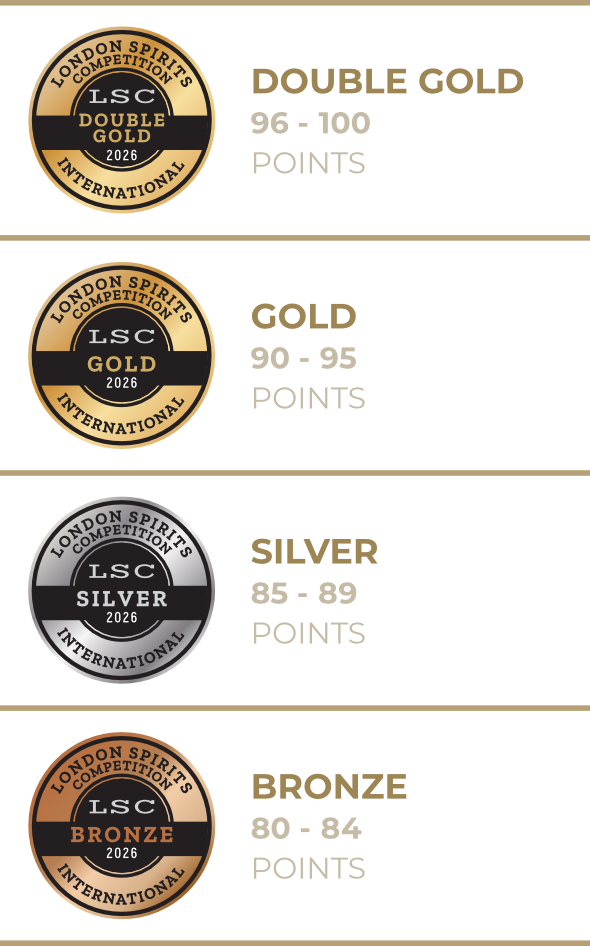
Image caption: Screenshot of the detailed score breakdown available under “My Results” in the Entrant Zone. Entrants can see how each spirit performed across Quality, Value and Packaging, together with its Final Score and Award.
The London Spirits Competition assesses spirits on three primary criteria: Quality, Value and Packaging.
Quality carries double the weight of Value and Packaging when the final competition score is calculated. This ensures that a spirit cannot succeed through attractive packaging or competitive pricing alone. It must first demonstrate genuine quality in the glass.
Value and Packaging are assessed separately because they answer different commercial questions.
Value considers whether the spirit delivers an appropriate drinking experience for its recommended retail price and intended market position.
Packaging considers how effectively the product will communicate and compete when presented to buyers and consumers.
The blind quality assessment remains the foundation of the complete judging process.
A major new benefit for entrants is constructive feedback explaining how the quality of their spirit could be improved.
Following the panel’s assessment, the Head Judge considers the observations made by all judges and the overall view of the panel. The Head Judge then prepares clear, constructive feedback for the entrant.
Depending on the spirit, this feedback may address areas such as:
- Balance between alcohol, sweetness, bitterness and flavour intensity
- Aromatic clarity and definition
- Expression of the base ingredient
- Botanical or flavour integration
- Oak and cask integration
- Texture and mouthfeel
- Concentration and complexity
- Alcohol integration
- Finish and length
- Technical faults or inconsistencies
- Alignment with the intended category and style
The purpose is not simply to identify weaknesses. The feedback is designed to give producers useful professional insight into how the spirit may be refined or improved.
Entrants will be able to access this feedback through their Entrant Zone alongside their separate quality score.
[[relatedPurchasesItems-63]]
Spirits judging requires professional judgement, but the London Spirits Competition follows a structured process to support fairness and consistency.
Each spirit is tasted by multiple trade professionals. Judges work with defined quality criteria, taste spirits in organised flights and record their assessments individually.
The panel can then review the spirit, with the Head Judge leading any discussion required when scores or opinions differ significantly.
Judges must also separate personal preference from professional assessment. They may not personally choose to drink every category or style presented, but they must recognise when a spirit is well made, balanced and successful within its intended category.
A judge who personally prefers whisky must still be able to recognise the quality of an expertly produced gin, vodka, rum, tequila, brandy, liqueur or other spirit.
Blind tasting at the London Spirits Competition is not only about finding faults or deciding which spirit tastes best.
It is a structured assessment of how successfully each spirit has been produced and how convincingly it delivers its intended style. By removing branding and packaging during the quality stage, the competition gives the liquid itself the opportunity to make the first impression.
Every spirit is assessed by multiple UK trade professionals, and every entrant receives a separate quality score out of 100. From 2027, entrants will also receive constructive quality feedback prepared by the panel’s Head Judge and based on the panel’s collective assessment.
For every entry, the process begins with the same fundamental question:
How good is the spirit in the glass?
Also Read:
How London Spirits Competition Judging Really Happens: Quality, Value and Packaging Explained
How Judges Assess Value at the London Spirits Competition
How Judges Assess Packaging at the London Spirits Competition
The 2027 London Spirits Competition gives every entrant greater feedback, transparency and valuable commercial insight. Entrants will receive an expanded score breakdown, constructive feedback on how to improve their spirits, guidance on how to market and sell them, the names of the judges who tasted their entries, final feedback from the Head Judge and a Buyer Market Intelligence Report.
Enter your spirits in the 10th edition of the London Spirits Competition.