Early Deadline
30 November 2026
Judging
Date
23 & 24 March 2027
Winners Announced
22 April 2027
30 November 2026
23 & 24 March 2027
22 April 2027

Every year, spirits producers from across the globe submit their products to the London Spirits Competition for evaluation by some of the beverage industry's most experienced professionals. For producers considering entering, it helps to know exactly how the competition works, what gets judged, and what the medals mean in practice.
The London Spirits Competition accepts entries across the complete range of spirits categories: whisky, gin, vodka, rum, tequila, brandy, liqueurs, flavoured spirits, and ready-to-drink spirit-based beverages, among others. Each category is evaluated separately, ensuring that products are compared against peers with similar characteristics rather than against entirely different styles.
A craft gin is judged alongside other gins. An aged single malt sits in a field of comparable whiskies. This structure means that category wins carry genuine meaning. They reflect performance within a relevant competitive set, not just relative to the overall entry pool.
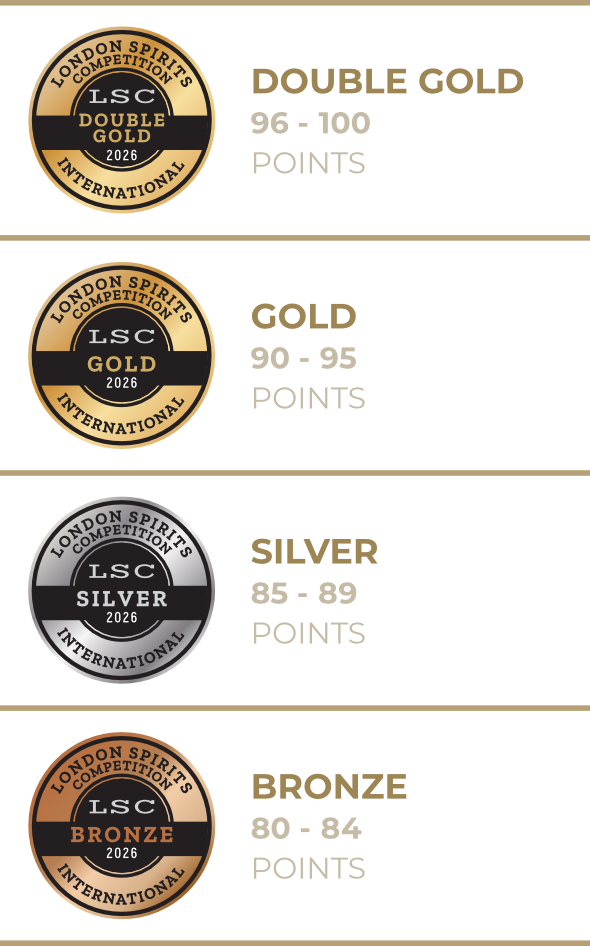
Medals are assigned based on the final score a spirit achieves during judging, with three levels of recognition reflecting different thresholds of performance. Gold medals go to spirits achieving exceptional scores across all judging criteria. Silver medals recognise products that perform strongly and meet a high standard of quality. Bronze medals are awarded to spirits that demonstrate solid industry-standard quality.
Beyond category medals, the competition also presents special awards to standout performers across the entire field. These include titles such as Spirit of the Year, Best Spirit by Country, Best Spirit by Category, and Distillery of the Year; recognition reserved for products that distinguish themselves not just within their category but against every other entry in the competition.
What sets the London Spirits Competition apart from many traditional awards is its judging framework. Rather than evaluating spirits on taste alone, judges assess each entry across three criteria that reflect how spirits are actually bought and sold in the real market.
Quality is the first and most fundamental dimension. Judges taste each spirit blind, evaluating aroma, balance, flavour complexity, texture and mouthfeel, and finish. The blind format ensures the liquid is assessed on its own merits, with no influence from brand recognition or packaging.
Value is the second criterion, and one that many producers underestimate. A spirit that delivers exceptional quality relative to its retail price will score well here. For buyers making decisions about what goes on a shelf or into a bar program, value for money is never an afterthought, it's central to whether a product is commercially viable.
Packaging is the third dimension. Bottle design, label clarity, visual impact, and overall brand presentation are all assessed because shelf presence directly influences whether a consumer picks up a bottle in the first place. A spirit that looks the part alongside one that doesn't will consistently outperform it at retail, regardless of what's inside.
The three-criteria approach gives producers something more useful than a simple score. It gives them a structured read on how their product performs across the dimensions that drive real purchasing decisions. A brand that wins on quality but scores modestly on value has actionable intelligence about its pricing strategy. One that performs well across all three criteria has demonstrated commercial readiness, not just liquid quality.
That distinction matters enormously when the results are put to work. Producers use medals across packaging, distributor presentations, marketing campaigns, websites, and social media. And the credibility of those medals depends entirely on the credibility of what they represent. Recognition from a competition that judges the way buyers think carries weight with the people producers are trying to reach.
For spirits brands serious about growing their presence in the global trade, that alignment between judging framework and commercial reality is precisely what makes the result worth having.
The 2027 London Spirits Competition gives every entrant greater feedback, transparency and valuable commercial insight. Entrants will receive an expanded score breakdown, constructive feedback on how to improve their spirits, guidance on how to market and sell them, the names of the judges who tasted their entries, final feedback from the Head Judge and a Buyer Market Intelligence Report.
Enter your spirits in the 10th edition of the London Spirits Competition.