Early Deadline
30 November 2026
Judging
Date
23 & 24 March 2027
Winners Announced
22 April 2027
30 November 2026
23 & 24 March 2027
22 April 2027
There are spirits built for occasion, and there are spirits built from obsession. Castle Freke belongs firmly to the latter.
Set on Ireland’s Atlantic edge, where weather seems to arrive with personality and force, Castle Freke Gin emerges not from a conventional distillery story, but from a place story — one rooted in inheritance, ruin, patience and return. Its maker, Stephen Evans-Freke, did not simply launch a gin brand; he appears to have spent years pursuing something more elusive: how to bottle the atmosphere of a landscape, the memory of a family seat, and a personal idea of elegance.
Castle Freke itself has watched over West Cork for centuries. The ancestral home of the Evans-Freke family, Lords of Carbery, it stood for generations before falling into abandonment — a dramatic shell, heavy with history and neglect. When Stephen Evans-Freke brought it back into family hands in 1999, and began its restoration a few years later, the project was about far more than architecture. It was an act of recovery, of listening closely to what a place had once been and what it still might become.
That same instinct seems to run through the gin.
Stephen’s relationship with gin began, fittingly, not in trend or novelty, but in ritual. A dry martini connoisseur since his Cambridge days, he spent over a decade refining a spirit that would meet his own exacting standards. The result is described as a “sipping gin,” which in lesser hands might feel like marketing shorthand. Here, it feels more like a philosophy. Castle Freke Gin was not conceived primarily as a mixer or a vehicle for garnish, but as something to be lingered over — a spirit meant to unfold slowly, revealing itself in stages rather than announcing itself all at once.
That sense of deliberation runs through every detail of its making. The recipe is said to have evolved through a proprietary 50-step process and long maturation, a slow and exacting approach that mirrors the restoration of the castle itself. Rather than aiming for loudness or instant recognisability, the profile seems to have been built around texture, restraint and depth. It draws on rare organic and wild-gathered botanicals sourced from a strikingly broad geography: juniper from Macedonia and Tuscany, coriander from the Nile Delta, estate myrtle from the Castle demesne, and rare citrus from the Pyrenean orchards of Agrumes Schaller. Yet for all that reach, the spirit remains anchored to its home terrain.
And that terrain matters.
West Cork is not simply the backdrop to this story; it is one of its central forces. Castle Freke stands above a landscape shaped by Atlantic weather, its trees bent by storm winds, its atmosphere charged with the kind of raw beauty that resists prettification. The estate’s spring water and wild-growing myrtle bring the place directly into the glass, but even beyond ingredients, the spirit of the coast seems embedded in the identity of the gin: resilient, elemental, a little severe, and all the more compelling for it.
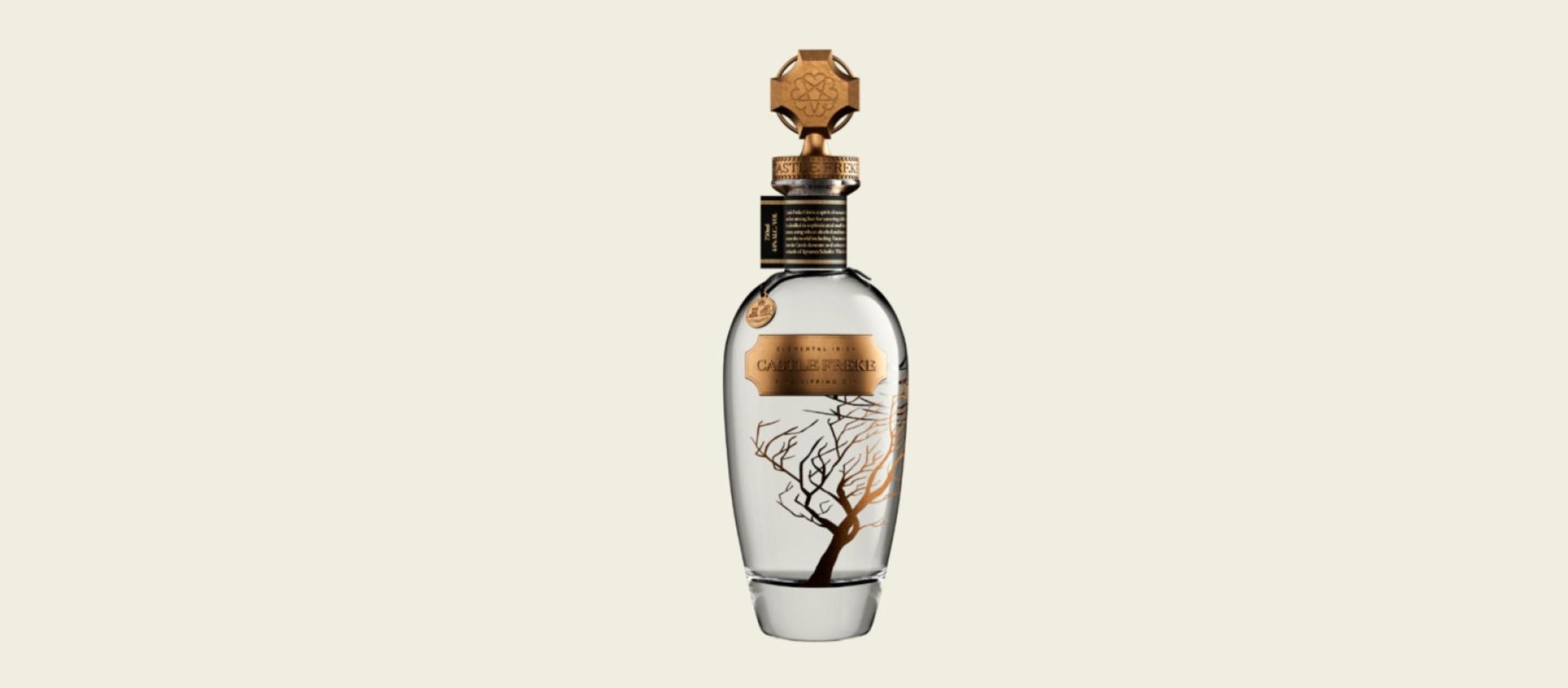
It is perhaps this tension — between refinement and wildness, ceremony and exposure — that gives Castle Freke its distinctive character. On one hand, there is intense precision: years of experimentation, microscopic care over botanicals, the pursuit of smoothness and structure. On the other, there is mythology, symbolism and an almost gothic attentiveness to place. The castle’s restoration is framed not only as a physical rebuilding, but as a renewal haunted, in the best sense, by older layers of meaning. Ancient symbols recur throughout the world of the brand: the Ouroboros, representing renewal and eternal return; the Flower of Life, with its sacred geometry; the Pentacle of Hearts, suggesting emotional intelligence and creative alignment. Even the bottle carries this symbolic vocabulary, from the wind-bent tree climbing its glass to the stopper inspired by the Carbery Celtic Cross.
Normally, such details might risk feeling overly composed. But in the case of Castle Freke, they feel consistent with the larger story. This is not a gin borrowing the language of myth to decorate itself; it is a product emerging from a house and landscape where history, symbolism and private meaning appear to have been lived with intimately. The bottle does not merely package the spirit — it extends the world that produced it.
What makes Castle Freke interesting, then, is not just that it is luxurious, rare or painstakingly made. It is that it seems to reject speed. In a culture that often rewards immediacy — quicker production, louder branding, more instant gratification — this is a spirit defined by long attention. It asks for stillness. It favours contemplation over performance. Even its stated aim of offering “a still point in a turning world” feels less like a slogan than a reflection of how it was conceived: slowly, privately, and with conviction.
That may be why the most compelling part of Castle Freke is not the aristocratic lineage, nor even the impressive ingredient list, but the personality behind it. Stephen Evans-Freke’s journey with the gin mirrors his restoration of the castle: both are acts of patience, taste and stubborn faith. Both suggest a refusal to settle for approximation. And both seem driven by the same question: what does it mean to restore something fully — not just structurally, but spiritually?
Castle Freke Gin offers one possible answer. It is less a product of fashion than of worldview, shaped by a man, a ruined castle, a battered coastline and the long discipline of trying to get something exactly right.
The 2027 London Spirits Competition gives every entrant greater feedback, transparency and valuable commercial insight. Entrants will receive an expanded score breakdown, constructive feedback on how to improve their spirits, guidance on how to market and sell them, the names of the judges who tasted their entries, final feedback from the Head Judge and a Buyer Market Intelligence Report.
Enter your spirits in the 10th edition of the London Spirits Competition.